-
AutoreMessaggi
-
-
Between Tribute and
Erasure: African
Musical Influence
and Cultural
Imperialism in
Western Classical
Traditions – A
Postcolonial
Critique.
Abstract:
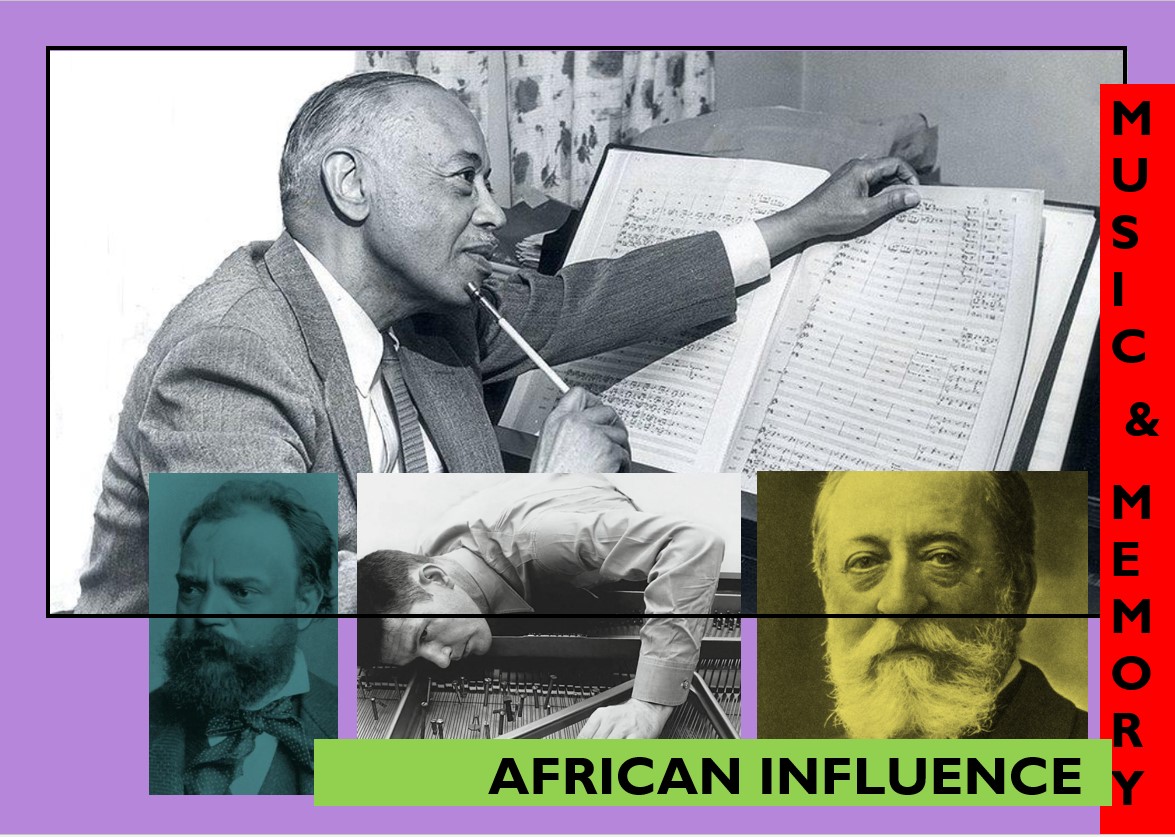
This article looks at a progression of African traditional elements into European composers from the late Romantic period into the 20th century. Composers like Camille Saint-Saëns, Antonín Dvořák, John Cage, E William Grant Still are examined for how they used African musical ideas sometimes as tribute, and other times through a colonial lens.
Introduction.
Towards the end of the 19th century we encountered a surge in Western composers’ engagement with non-European musical cultures, facilitated by the rise of colonial travel, and global trade. Triggering a wave of music that drew inspiration from Africa, Asia, e il Middle East, following the trend of Romantic Exoticism.
In this article I track the underexplored history of fusion of African traditional elements with Western Art Music pre and post the turn of the 19th century via Camille Saint-Saëns, Antonín Dvořák, William Grant Still E John Cage.
West African Oral Traditions: Memory in Music:
Traditional West African music varies considerably across regions – reflecting the wide range of cultures, languages, and histories – but some shared characteristics are notable and essential to understanding its influence. In many West African traditions, music often serves as a mnemonic tool for oral storytelling, preserving cultural memory, history, and identity across generations. Rhythmic complexity, including polyrhythms*, syncopation*, E call-and-response is especially prominent, particularly in ensemble and communal settings, sometimes facilitating an emphasis on percussion. Additionally, repetition and ostinato patterns frequently serve as structural anchors in performance and composition.
Saint-Saëns’ Suite Algérienne (Op. 60) and Africa Fantasia (Op. 89): Exoticism and Cultural Imperialism:
Saint-Saëns’ two pieces act as musical artefacts of French imperialism. The composer frequently visited North Africa, specifically Algerian cities (a French colony in various forms between 1830 E 1962), where he transcribed, or arguably appropriated, folk melodies from native communities. Whether these pieces can be clearly understood as tributes or not, his musical engagement was shaped by the broader context of colonial power.
Composed in 1880, IL ‘Algerian Suite’ was dedicated to Albert Kopff, a French colonial administrator based in Algeria. This dedication alone reinforces the work’s entanglement with colonial structures. Though the work doesn’t explicitly quote any Algerian folk tunes or in fact include many distinctly Algerian musical features at all, it nonetheless perpetuates an orientalist aesthetic. Rather than representing Algeria authentically, the most ‘Algerian’ elements appear as slight modal inflections and decorative ornamentation, particularly evident in the rapid woodwind trills in dialogue with the string section.
The most convincing portrayal of Algeria emerges in the richly orchestrated first movement. A swelling chorus of horns and trumpets portrays the image of a boat gliding across the sea, approaching the Algerian coast. Scalic violin lines evoke ripples in the water, while expansive string chords layered over a meandering cello motif reinforce the sea-like imagery. However, this is less a specific depiction of Algeria – rather a romanticised coastal fantasy shaped more by imagination than by place.
Furthermore, Saint-Saëns’ ‘Africa’ fantasia makes seemingly no effort to acknowledge the vast difference in culture, music and people from region to region across Africa. His composition only seems to acknowledge Northern African musical elements (and hardly at that), whilst neglecting the rest of the continent, using a smattering of polyrhythms and percussion as an adequate portrayal of Africa. Again, Saint Saens abruptly introduces a scale of augmented seconds, scantily resembling Algerian modal scales towards the end of Op. 89, before ending firmly in the home key.
This same theme continues in his Suite Algérienne. The final movement is a bold French military march, a clear marker of musical symbolism that reinforces the colonial authority of France in North Africa during the late 19th century. This musical gesture, set against the backdrop of ‘exotic’ motifs, creates an unsettling juxtaposition: Africa imagined, portrayed, and ultimately disciplined under the stamp of an empire. Especially as the fourth movement functions as the symphony’s conclusion, it conveys a triumphant and final assertion of French power.
While these gestures could be read as appreciation, they often function as remnants of colonial dominance, particularly when they ignore power imbalances and lack cultural context. This is especially troubling in a composition overtly dedicated to another region. In such cases, the incorporation of folk elements seems superficial, reducing rich musical traditions to aesthetic flourishes rather than engaging with them in a meaningful or appreciative way.
IL ‘Africa’ Saint-Saëns conveys is one controlled, restricted and overpowered by its colonial powers at the time – with one of the key tools in establishing power being erasure and suppression of culture. This musical Africa is essentially muffled by a colonial mindset that reduced cultural depth to aesthetic flourishes.
Of course, it would be unfair to expect 19th-century composers to meet the standards of cultural awareness there is today. But even in their own time, the failure to identify sources clearly, or to recognise the difference between distinct musical cultures, like Saint-Saëns using ‘Algerian’ ideas to represent all of “Africa” – shows a habit of generalising that erases cultural depth. Whether intentional or not, this kind of musical borrowing often results in shallow portrayals that miss the complexity of the traditions they claim to celebrate.
Bridging Worlds: Dvorak’s ‘New World’ Symphony:
Though only 13 years apart, Saint-Saëns'sabbia Dvořák’s treatments of non-European musical traditions differ significantly, the former shaped by colonial power dynamics and the latter by a more engaged and less exploitative musical relationship, which is seen in Dvorak’s ‘New World’ symphony.
Dvořák arrived in the NOI In 1892 at the invitation of Jeanette Thurber, the founder of the National Conservatory of Music in New York City. He was tasked to assist in leading the conservatory, and helping American composers curate a distinctive musical identity from the prevalent European schools of the time.
Through his collaboration with Harry T. Burleigh, a Black singer and composer, Dvořák gained exposure to African-American spirituals – songs passed down by enslaved Africans that retained pentatonic scales*, call-and-response*, heavily syncopated rhythms* and placed an emphasis on oral memory, derived clearly from Western African Oral traditions.
Notwithstanding that African-American spirituals were often overlooked and dismissed at the time, Dvořák recognised their depth and complexity, famously stating;
“In the Negro melodies of America I discover all that is needed for a great and noble school of music.”
Rather than quoting these songs directly, he composed in the ‘spirit’ of spirituals, blending their melodic and rhythmic features with the formal structure and functional harmony of Western symphonic tradition. One clear example appears in the first movement of his Ninth Symphony, where a lyrical motif inspired by “Swing Low, Sweet Chariot” emerges gently in the low flute register, just moments after a lively Bohemian folk passage. This interplay of cultural influences reflects Dvořák’s ambition for genuine cross-cultural exchange. By juxtaposing these two traditions so starkly, he forges a new path for American composition, treating both musical sources with equal creative value, rather than as exotic ornamentation.
Composing from Within: William Grant Still’s Afro-American Symphony:
In contrast to Dvořák’s external engagement, William Grant Still’s Afro-American Symphony (1930) emerges from within the African-American tradition itself at the height of the Harlem Renaissance. Still incorporated 12 bar blues* chord progressions, modal harmony*, syncopated rhythms, and improvisatory gestures – all akin to jazz – infusing them into the classical symphony, to achieve a balance between Western structure and African-American expression.
Still’s use of brass instruments such as trumpet and trombone as low brassy melodic voices is particularly significant. These instruments, central to both early jazz and blues, have a vocal sonority that echoes Western African Oral tradition’s emphasis on voice as a primary instrument centuries later.
John Cage’s Bacchanale: Texture and Timbre as Rhythm:
By the 1940s, the influence of African music began to appear in more abstract, experimental contexts. John Cage’s Bacchanale (1940), composed for Syvilla Fort, a Black choreographer who requested a piece with an “African inflection”, exemplifies this trend. Cage, dissatisfied with the harmonic constraints of Western classical tradition, turned toward sonority and rhythm, drawing loosely from what he perceived as African musical qualities.
His solution was the invention of the prepared piano, altered with bolts, screws, and weather stripping to mimic percussive effects. Each note produces a distorted but shimmery timbre with an initial hard attack* E short decay*, emphasizing the instrument’s unusual percussive effect. The piece remains largely atonal and avoids harmonic development, instead prioritising texture and rhythm. Cage utilises intricate polyrhythms to create a layered and dynamic sound, as well as alternating awkwardly between block chords and disjunct scalar fragments, filtered through a Western Avant garde aesthetic – manufacturing a complex and unsettling texture throughout the piece.
Mentre Bacchanale does not directly quote or reference African musical sources, its stylistic elements reflect a broader trend of appropriating non-European musical traits as material for experimentation. The emphasis on rhythm and percussion, key features in many West African traditions, may be what Cage attempts to allude to throughout the piece, however these musical gestures fall short of meaningfully representing the ‘African’ tradition they claim to represent.
Bacchanale stands as a landmark in 20th-century music, introducing the prepared piano and expanding the possibilities of Western instrumentation and composition. Yet like Saint-Saëns before him, Cage engages non-European influence through vague, stylised details that have no ties to a particular culture or tradition. His portrayal of ‘Africanness’ appears superficial rather than informed, reflecting a broader pattern in Western composition where non-European elements are treated as aesthetic embellishments rather than seriously explored or understood.
The result is a work that, while groundbreaking in instrumentation, reflects the ongoing legacy of orientalism in Western Art Music.
Conclusione:
In an era when colonialism and culture were so tightly intertwined, it’s impossible to fully separate artistic inspiration from the systems of power that shaped the music. While some composers, like Dvořák, made efforts to engage more carefully, the legacies of cultural erasure and oversimplification still linger in how non-European music was used in classical composition.
That said, the history of musical exchange is not solely defined by misuse or appropriation. Jazz, for example, shows what happens when African rhythmic traditions and Western harmonic forms truly interact. Rather than flattening or exoticising, jazz builds something new from both worlds – something expressive, complex, and rooted in lived experience. It offers a glimpse of what reciprocal musical exchange can look like, and acts as a reminder that influence does not have to mean erasure.
Footnotes / References: ***
*pentatonic scale (five-note scale which does not contain the fourth and seventh note of a traditional European major scale)
*syncopated rhythms (a shift of accent that occurs when a normally weak beat is stressed)
*decay (the way a note fades or dies away after being played, affecting its length and texture)
*polyrhythms (multiple contrasting rhythms played at the same time, creating layered and complex patterns)
*timbre (the unique tone or colour of a sound that distinguishes one instrument or voice from another)
*hard attack (a note that begins sharply and suddenly)
*12-bar blues (a chord progression built over 12 measures, typically using the I, IV, and V chords, forming the harmonic foundation of many blues and jazz pieces)
*modal harmony (harmony based off alternative scales to the major and minor — often creating a more ambiguous or folk-like sound)
-
Thank you for the very indepth article on African music, from a historical standpoint.
It confronts deep ethical questions about artistic representation, cultural ownership, and the moral responsibilities of creators. At its core is a question central to aesthetics and postcolonial ethics: Can art divorced from context be ethically neutral?!
The appropriation of African musical ideas — especially by figures like Saint-Saëns or Cage — raises issues of epistemic injustice, a concept articulated by philosophers like Sylvia Wynter, bell hooks, Frantz Fanon, et-al. Musical exoticism often ignored the knowledge systems, historical specificity, and symbolic weight of the traditions they borrowed from, reducing them to ornamental features in a Western sonic vocabulary. The result is a form of aesthetic erasure, where the identity of the original culture is both invoked and silenced.
Interestingly it manifests in forms in which cultures seen as “other” are often objectified or instrumentalized to develop the identity of the dominant one. The musical Other becomes a tool in the self-fashioning of Eurocentrism.
-
-
AutoreMessaggi


Devi essere loggato per rispondere a questo argomento.